

Performance Marketing vs Digital Marketing (2026): Which One Should You Learn?

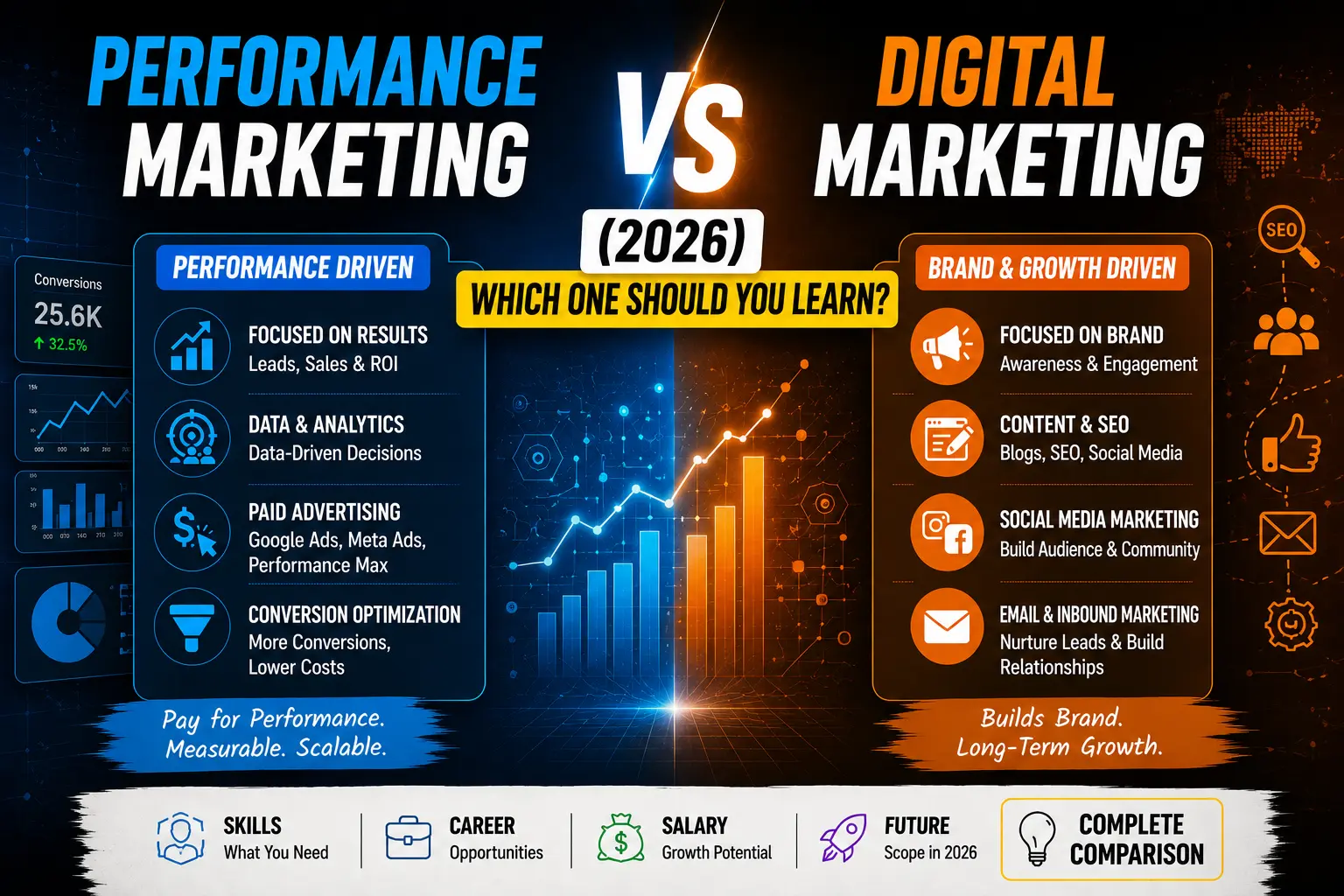
If you’ve been searching for performance marketing vs digital marketing and still aren’t sure what the difference is you’re in exactly the right place. These two terms are all over the internet in 2026, and the confusion is totally normal. Even experienced marketers mix them up, so don’t worry!
Think of it this way: digital marketing is like a big umbrella it covers everything from social media posts and blog writing to email newsletters and SEO. Performance marketing, on the other hand, is a focused slice of that umbrella where you only pay for real results like clicks, leads, or actual sales. So when people compare performance marketing vs digital marketing, they’re really asking: do you want to learn a bit of everything, or go deep on one skill that directly ties to money?
By the end of this guide, you’ll know exactly which path makes more sense for you, no confusion, just a clear and honest answer.
If you’re completely new to paid advertising, you should also read my guide on Google Ads in 2026: The Complete Guide to What’s Actually Changing.
Key Takeaways
- Performance marketing = pay only for results
- Digital marketing = broader strategy (SEO, content, social)
- Performance marketers earn 20–40% more
- Beginners: Start with digital marketing first
- 2026 top skills: Google Ads + Meta Ads
Difference between performance marketing and digital marketing
Performance marketing and digital marketing are related but fundamentally different in approach and accountability.
Digital marketing is a broad strategy that includes SEO, content marketing, social media, email campaigns, and paid advertising — with the goal of building brand awareness and online presence over time.
Performance marketing is a results-driven subset of digital marketing where brands only pay when a measurable action occurs — such as a click, lead, form submission, or purchase.
Key Stat: According to WordStream (2025), performance marketing campaigns deliver an average ROAS (Return on Ad Spend) of 4:1, compared to 1.5:1 for general brand awareness campaigns.
| Factor | Digital Marketing | Performance Marketing |
|---|---|---|
| Payment Model | Fixed budget | Pay-per-result |
| Goal | Brand awareness + growth | Direct conversions |
| Measurability | Moderate | Very high |
| Best for | Long-term brand building | Immediate ROI |
| Risk Level | Medium | Low |
Performance marketing is a results-based model where brands
pay only for completed actions like clicks, leads, or sales.
Digital marketing is a broader strategy covering SEO, content,
social media, and email — focused on long-term brand growth.
What Even Is the Difference? (And Why It Actually Matters)
The confusion is understandable. Both DM (Digital Marketing) and PM (Performance Marketing) deal with channels like Meta Ads, Google Ads, SEO, and content. But the mindset is fundamentally different.
Think of it this way a Digital Marketer asks: “How do I get more traffic?” A Performance Marketer asks: “How do I get traffic that actually converts and makes money?”
That one shift in thinking changes everything the strategies you use, the metrics you care about, and ultimately, what you’re worth to a business.
The Digital Marketer’s Lens
A typical digital marketer’s job is to bring traffic to a website or generate leads across different platforms. They’ll run campaigns on Meta, Google, run SEO, create content and their success is measured in:
- Website traffic volume -how many people clicked?
- Lead count – how many form fills or enquiries came in?
- CPC (Cost Per Click) – how cheaply can I get clicks?
- Impressions and reach – how many people saw the ad?
Nothing wrong with this. It’s legitimate work. But notice most of these metrics stop at the top of the funnel. The question “did those leads actually convert into paying customers?” is often someone else’s problem.
The Performance Marketer’s Lens
A performance marketer tracks the same traffic but won’t rest until they know the full story: how many of those visitors actually bought something, booked a call, or completed a sale. The metrics they live by are:
- Conversion Rate – what % of visitors take the desired action?
- Qualified Leads – are the leads actually the right audience?
- Cost per Acquisition (CPA) – what does it cost to get one paying customer?
- ROAS (Return on Ad Spend) – for every ₹1 spent, how much came back?
- Revenue generated – the most important number of all
Real-World Example
The Real Estate Campaign – Same Budget, Very Different Results
Imagine you’re running leads for a real estate client selling ₹2 Crore flats in Delhi.
Digital Marketer Approach
Ad copy: “Best Flats in Delhi 3BHK Available!” Gets 200 leads. But many are people looking for ₹40–₹80 lakh flats. Sales team spends hours calling unqualified leads. 5 conversions.
Performance Marketer Approach
Ad copy: “3BHK Luxury Flats Starting ₹2 Crore.” Gets 100 leads. Only people with that budget click. Sales team makes fewer but sharper calls. 20 conversions.
Key Takeaway
The performance marketer had half the leads but 4x the conversions with less cost, less effort, and far better ROI for the client. That’s the power of thinking beyond clicks.
Skills Required: DM vs PM in 2026
The skill sets overlap significantly but Performance Marketing demands more. Here’s an honest breakdown:
Digital Marketing
- Platform tools – Meta Ads Manager, Google Ads
- SEO basics – on-page, off-page, technical
- Excel / data analysis – 80% of your time
- Reporting – creating clear campaign reports
- Communication – working with clients and teams
- Social media management
- Email marketing fundamentals
Performance Marketing
- Everything in DM – full overlap
- Paid ads mastery – Meta, Google, YouTube, native
- Business understanding – what does this client actually need?
- Copywriting – especially conversion-focused ad copy
- Funnel building – top, middle, bottom of funnel strategy
- CRO (Conversion Rate Optimisation)
- Offer creation – what makes people say yes
- Landing page strategy
- Data → decisions – not just reports, real optimization
For beginners learning campaign setup, my step-by-step tutorial on How I Set Up Google Performance Max Campaigns will help you understand real campaign structure and optimization.
The biggest difference? A performance marketer needs business acumen. You’re not just running ads you’re thinking like a business owner. What’s the lead quality? What’s the sales cycle? Is the bottleneck the ad or the landing page or the offer itself?
And copywriting is arguably the most underrated skill here. The right ad copy doesn’t just attract clicks it self-qualifies your audience before they even land on your page. That’s why I’ll be doing a dedicated deep-dive on copywriting in a future post.
Let’s Talk Money Income & Growth in 2026
I know this is what most of you actually want to know. So let me be direct, based on what I’ve personally seen.
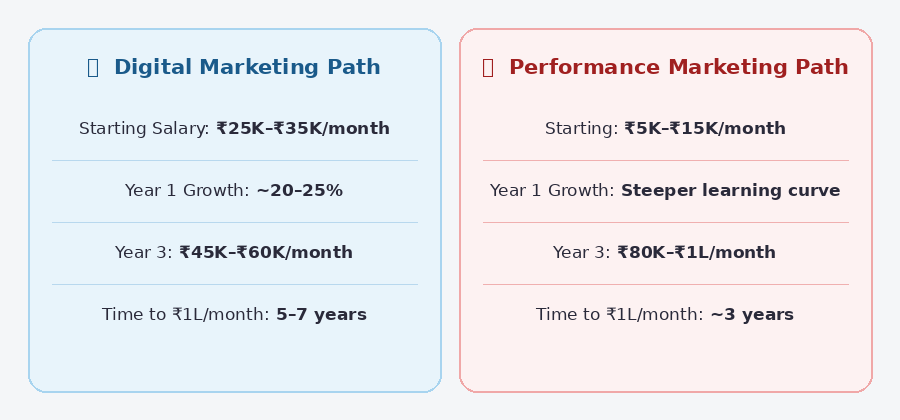
Reality Check
Performance marketing often starts slower. The first few months can feel tough. But the trajectory after Year 1? It’s almost vertical compared to the steady, incremental growth of a traditional DM career. By Year 4–5, performance marketers are routinely doing ₹3–5 lakh/month especially if they go independent or freelance.
Why Does Performance Marketing Pay More?
Simple: you’re directly creating measurable value for the client.
Here’s a real example I love to explain this. Say you’re a CRO (Conversion Rate Optimisation) specialist. A client has a landing page where 100 visitors = 1 purchase. Their product is $1,000. So 100 visitors = $1,000 in revenue.
You rewrite the copy, restructure the page, sharpen the offer. Now 100 visitors = 3 purchases. Same traffic. Same ad spend. But now they’re making $3,000 instead of $1,000.
If you’re on a 30% revenue-share deal, that’s $900 from a single landing page improvement. No additional traffic. No more budget. Just better thinking.
That’s why a performance marketer can name their price. They’re not selling hours they’re selling outcomes that businesses can directly see in their bank account.
Which One is Right for YOU?
Honestly? It depends on what you want from your career. Here’s how I’d break it down:
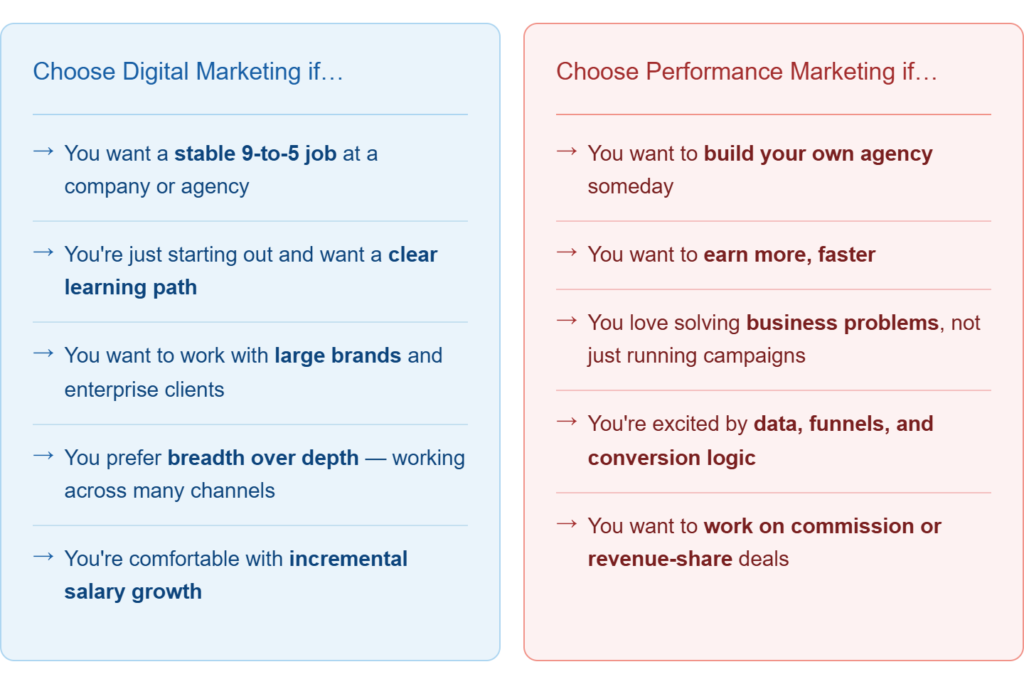
Neither path is wrong. But I’ll be honest if you’re asking me where the ceiling is higher, the answer is performance marketing. Every time.
2026 Update – What’s Changed?
According to LinkedIn’s 2025 Jobs Report, performance
marketing roles grew 34% year-over-year with 28% higher
average salaries than general digital marketing roles.
The landscape has shifted significantly since 2023–24. Here’s what I’m seeing in 2026 that you absolutely need to know:
- AI-generated creatives are everywhere – which means copywriting and strategy matter more than ever. Anyone can make an ad. Very few can make an ad that converts at 4%.Platforms like Meta and Google are rapidly shifting toward AI-driven advertising. If you want to understand this shift better, read my article on Google Demand Gen: How Smart Brands Create Demand Before Customers Start Searching.
- Meta’s algorithm has gotten smarter – but also less predictable. Performance marketers who understand the “why” behind campaign structure are surviving. Those running on autopilot are bleeding budget.
- First-party data is now king – with cookie deprecation fully in effect, performance marketers who understand email lists, CRM integration, and retargeting via owned data are commanding premium rates.
- Video-first funnels are standard – Short-form video (Reels, YouTube Shorts) is now a primary conversion driver, not just a brand-awareness tool. Performance marketers who can script and structure video ads have a serious edge.
- Performance marketing freelancers are thriving – The demand for skilled, ROI-focused marketers has outpaced supply. If you’re good, you will not be unemployed in 2026.
- The “spray and pray” digital marketing model is dying – Clients are increasingly demanding performance accountability. Even traditional digital marketing roles are slowly adopting performance KPIs.
A Note on Making This Blog Even Better (EEAT Improvement):
To fully satisfy Google’s EEAT (Experience, Expertise, Authoritativeness, Trustworthiness) requirements, I’d recommend adding the following to your website/this post:
1. A dedicated “About Kuldeep” page with your client portfolio, past results, and certifications (Meta Blueprint, Google Ads, etc.) – this builds Authoritativeness.
2. Real screenshots or case studies from campaigns you’ve run (blurred if needed) – this shows Experience over just claimed expertise.
3. A byline photo and LinkedIn / social link on each blog – Trustworthiness signal.
4. Cite any data or salary ranges from platforms like LinkedIn Salary, AmbitionBox, or Glassdoor – makes your claims verifiable.
5. Consider adding a “Last Updated” date to each post – Google rewards freshness, especially for career content.
Need Help with Google Ads, Meta Ads, or Performance Marketing?
I help businesses improve:
- Lead generation
- Ad performance
- Conversion tracking
- Marketing strategy
- ROI from paid campaigns
If you want practical guidance tailored to your business, let’s connect.
Frequently Asked Questions
Q1. What is the main difference between Performance Marketing and Digital Marketing?
Digital Marketing focuses on driving traffic and generating leads across platforms like Meta and Google. Performance Marketing goes a step further it tracks whether that traffic actually converts into sales or revenue, making every rupee of ad spend accountable.
Q2. Which one pays more Digital Marketing or Performance Marketing?
Performance Marketing pays significantly more and grows faster. A performance marketer can reach ₹1 lakh/month in about 3 years, while a digital marketer typically takes 5–7 years to reach the same level.
Q3. Do I need to know Digital Marketing before learning Performance Marketing?
Yes, Performance Marketing includes everything Digital Marketing covers, plus more. Skills like paid ads, Excel, reporting, and communication are common to both. Performance Marketing then adds copywriting, funnel building, CRO, and business understanding on top.
Q4. Is Performance Marketing only for freelancers and agency owners?
Not at all. While it’s especially powerful for freelancers and agency builders due to revenue-share deals, performance marketers are also highly valued inside companies and brands that want measurable ROI from their ad budgets.
Q5. What skills should I focus on first if I want to start Performance Marketing in 2026?
Start with Meta Ads and Google Ads (paid tools), then build your Excel and data analysis skills. Once you’re comfortable, layer in copywriting and conversion rate optimisation (CRO) these two skills will separate you from 90% of marketers in the market.
Conclusion – My Honest Take
Look, both performance marketing and digital marketing are legitimate career paths. I’m not here to dismiss one and hype the other. But if you’re asking me which one gives you more control, more income, and more long-term leverage performance marketing wins, hands down.
The reason is simple: performance marketers create direct, measurable business value. You can sit across a table from a client and say “I spent ₹1 lakh on your ads and brought back ₹4 lakh in revenue.” That conversation is impossible to have if you’re just tracking clicks and impressions.
If you’re just starting out, don’t be discouraged by the lower starting salary. The learning curve is steeper, yes but so is the reward. Master paid ads, study copywriting, understand business funnels, and develop the habit of asking “but did it convert?” on every campaign you touch. Do that consistently, and ₹1 lakh a month becomes a floor, not a ceiling.
Digital marketing gets you a job. Performance marketing builds a career or a business.
I’ll be going deeper on copywriting, CRO, and funnel-building in upcoming posts. Stay tuned and if you have questions, drop them in the comments.
If you want measurable, trackable results with clear ROI — performance marketing is the better choice. If you’re building a brand for the long term — digital marketing gives you the broader foundation.
Whether you choose digital and performance marketing as separate paths or master both together — the key is to start today.
Ready to Grow with Smarter Marketing?
The digital marketing industry is changing rapidly in 2026. Businesses that understand Google Ads, AI-driven campaigns, funnels, and performance marketing will have the biggest advantage.
If you want help building a smarter marketing strategy for your business, book a free consultation call.
