

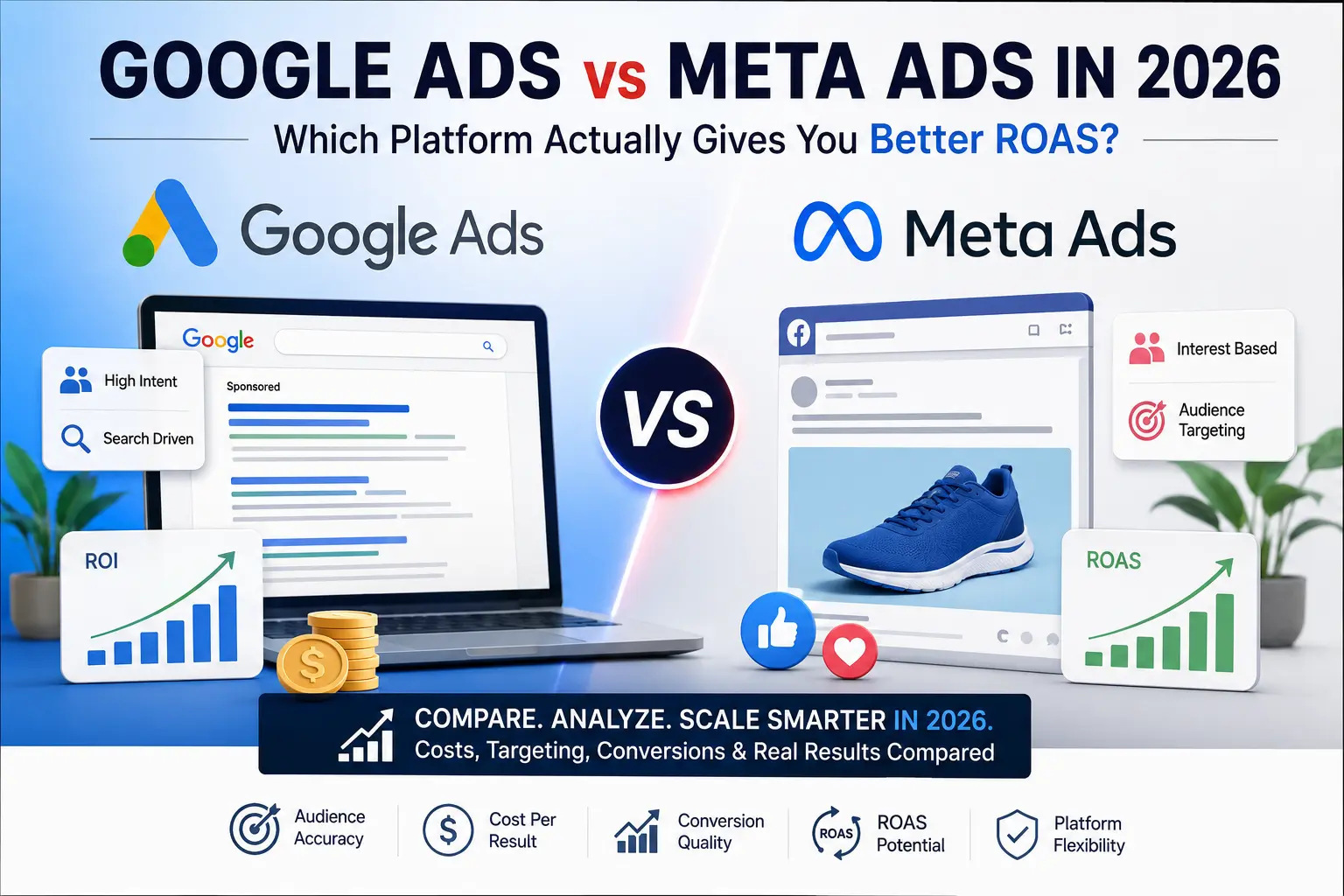
Google Ads vs Meta Ads in 2026: Which Platform Actually Gives You Better ROAS?

Introduction
Google Ads vs Meta Ads 2026 – every business owner running paid ads eventually faces the same question: should I put my budget into Google Ads or Meta Ads?”
In 2026, both platforms have evolved significantly smarter algorithms, rising CPCs, and new AI-driven features have changed the game. But the core question remains: which one actually gives you better ROAS for your business?
In this guide, we break down Google vs Meta across 6 critical dimensions from funnel depth and audience targeting to platform complexity and cost so you can make a data-backed decision (or learn how to use both strategically).
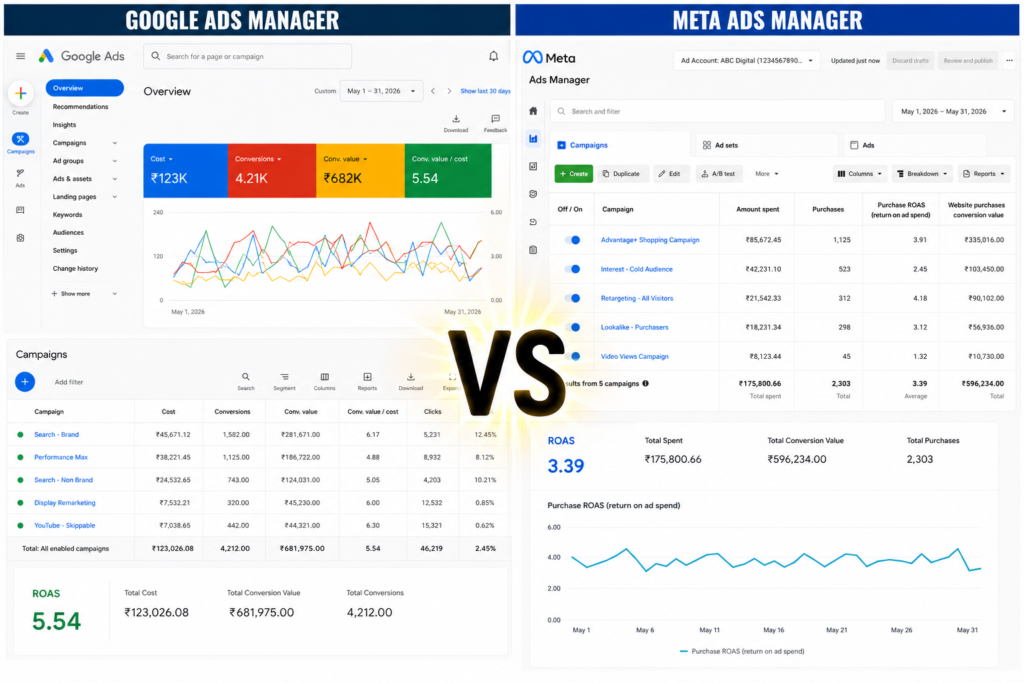
The Real Question You Should Be Asking
Most advertisers come to me with the wrong question. They ask: “Which platform is better?”
The right question is: “Which platform is better for MY business, MY product, and MY stage of growth?”
Because here is the truth Google Ads and Meta Ads are not competing for the same job. They do fundamentally different things. And once you understand that, you will stop burning money on the wrong platform.
Let me compare them across six core competencies that actually matter.
1. Awareness Stage: Who Reaches Your Customer First?
Before we talk about platforms, you need to understand where your customer actually is in their journey. Every buyer sits in one of five buckets:
- Problem Unaware – they don’t even know they have the problem yet
- Problem Aware – they know the problem exists but aren’t searching for solutions
- Solution Aware, Brand Unaware – they know solutions exist but haven’t heard of you
- Solution Aware, Brand Aware – they know you, but haven’t decided yet
- Ready to Buy – credit card is out, they just need the right nudge
Here’s where it gets interesting:
Google absolutely dominates the last stage. When someone types “best gym membership near me” or “book flight to Dubai” – they are ready. Google is right there to close the deal.
But what about the first three stages? What about the person who doesn’t even know your product exists yet?
That’s where Meta wins and it’s not even close.
Meta can introduce a problem to someone before they even knew they had it. Think about a productivity app, a new fitness course, an innovative skincare brand, or a niche B2B tool. Nobody is Googling these things because they don’t know they need them yet. Meta puts it in front of them while they’re scrolling, and suddenly — they want it.
Winner for Awareness Versatility: Meta Ads
Google Demand Gen: How Smart Brands Create Demand Before Customers Start Searching
2. Funnel Building & Algorithm Depth
This is where Meta starts to show its real power and where Google Search has a structural limitation.
Google Search is reactive. It waits for someone to type something. You can’t move a cold audience to a warm one through search alone. There’s no methodology inside Google Search to build a journey. You’re just waiting for intent to show up.
Meta is proactive. You can build an entire customer journey inside the platform:
- Stage 1: Introduce the problem (cold audience, broad targeting)
- Stage 2: Educate and build trust (video views, engagement retargeting)
- Stage 3: Retarget warm audiences with a specific offer
- Stage 4: Reframe objections and push to conversion
- Stage 5: Convert with a direct response ad
This is a full funnel built inside one platform. And the more time and data you give Meta, the smarter it gets. It learns what people watch, what they skip, what they engage with, and it connects that to purchase intent.
Google understands what people type. Meta understands what people want.
One gives you faster results. The other compounds results over time.
Winner for Funnel Building: Meta Ads
The Best Google Ads Account Structure for 2026 – A 3-Step Framework That Actually Works
3. Demand Capture: Who Wins When Intent Is High?
This one is Google’s domain. Full stop.
When there is existing demand people already searching for what you sell Google Search is the most efficient tool ever built for capturing it.
Think about these examples:
- Someone searching for “camping gear under 5000 rupees” → they want to buy now
- Someone looking for “best plastic surgery clinic in Mumbai” → high intent, ready to consult
- A business owner searching “enterprise CRM software” → serious buyer
- Someone typing “cheap flights to Goa this weekend” → about to book
In all of these cases, Meta cannot compete. The person already has their wallet out. You don’t need to educate them or build awareness. You just need to show up with the right ad at the right moment.
This is also why high-ticket industries love Google Search. Real estate, B2B SaaS, legal services, medical procedures industries where one sale covers months of ad spend they don’t flinch at high CPCs because the intent quality is so strong.
Winner for Demand Capture: Google Ads
How I Set Up Google Performance Max Campaigns (Step-by-Step Guide for 2026)
Confused Between Google Ads & Meta Ads?
Choosing the wrong platform can waste months of budget and testing.
If you want help deciding whether Google Ads, Meta Ads, or a hybrid strategy is best for your business, I can help you build a profitable acquisition system.
4. Scalability: Which Platform Grows With You?
Here’s a problem most growing businesses hit on Google Search and nobody warns them about it early enough.
Demand has a ceiling.
Let’s say you’re running a food delivery app in Jaipur. There are only so many people searching “food delivery near me” every day. You capture 20%, then 30%, and things are going great. Then a well-funded competitor enters the market, pours massive budget into Google, CPCs spike, and your efficiency drops overnight. You didn’t do anything wrong. The market just ran out of room.
Meta doesn’t have this problem at least not in the same way.
On Meta, as you scale your budget, the algorithm gets more data to work with. More data means better optimisation. Better optimisation means better results at scale. The efficiency can actually improve as you spend more — something Google Search cannot offer in the same way.
Meta also has significantly higher saturation ceilings. You can expand into new audiences, new creatives, new angles the platform keeps finding new people who look like your buyers.
Winner for Scalability: Meta Ads
5. Creative Leverage & Ad Diversity
This is the competency that separates strong marketers from average ones.
Here’s an honest comparison:
Google Ads is like a dating app profile. You have a headline. A couple of lines of description. That’s it. You’re trying to make someone click based on 100 characters and a URL.
Meta Ads is like a Netflix trailer. You have 15 seconds to make someone feel something. To get them curious. To make them want more. You have video, images, carousels, stories, reels, and copy all working together.
For most brands especially those selling products or services that need to be seen, felt, or experienced — Meta’s creative canvas is simply more powerful.
This is also why the best marketers love Meta and weak marketers blame Meta. On Google, a decent keyword strategy and good bidding can still perform. On Meta, if your creative is weak, nothing else matters. The creative IS the targeting. The creative IS the hook. The creative IS the reason someone stops scrolling.
Winner for Creative Leverage: Meta Ads (slight edge)
6. Platform Complexity: How Hard Is It to Win?
Let’s be honest about the learning curve here.
Google Ads is easier to start with. Decent keyword research, a solid bidding strategy, good landing pages and you can be profitable. The platform is more forgiving. Even average strategy can get average-to-good results.
Meta Ads is harder and more punishing if you get it wrong. To win on Meta, you need:
- Strong tracking setup (pixel, CAPI, events)
- A creative system that produces and tests multiple ad angles
- Funnel architecture with proper audience segmentation
- Patience results compound slowly before they compound fast
- Solid fundamentals (offer, landing page, CRO)
If your fundamentals are weak, Meta will burn your budget fast and show you nothing in return. But if you get it right, the ceiling is much higher than Google.
Winner for Ease of Use: Google Ads
“Platform Complexity: How Hard Is It to Win?”
Most businesses struggle not because ads don’t work but because the strategy behind them is wrong. If you want help building a profitable campaign structure, reach out here:
2026 Update: How AI Has Changed the Game
In 2024 and 2025, both platforms went through a massive AI-driven shift that every advertiser needs to understand going into 2026.
On the Google side:
- Performance Max (PMax) has become the default campaign type for most advertisers. It runs across Search, Display, YouTube, Gmail, and Maps all from one campaign. The control is lower, but the reach is wider.
- Demand Gen campaigns now directly compete with Meta for social-style placements on YouTube and Gmail.
- AI-generated search ads and responsive assets mean Google now needs less from advertisers but the creative and asset quality you feed the algorithm matters more than ever.
On the Meta side:
- Advantage+ campaigns have taken over. Meta’s AI now handles audience selection, placements, budgets, and creative combinations automatically.
- The creative signal has become even more important. Meta’s algorithm needs good raw material (videos, images, copy variations) to find what works. If you give it weak creative, AI amplifies the weakness.
- Instagram Reels placements are now among the highest-converting surfaces for consumer brands.
The 2026 reality: Both platforms are more AI-dependent than ever. The advertiser’s job has shifted from micro-managing targeting to feeding the algorithm with quality inputs good creative, good offers, good data from your CRM and pixel.
If you compare Meta Ads alone vs Google Search alone, Meta still has more ceiling. But if you compare Meta vs Google’s full ecosystem (PMax + Demand Gen + YouTube), then honestly it’s too close to call. Both can deliver exceptional results for the right business.
When to Start With Google. When to Start With Meta.
Start with Google Ads if:
- There is clear search demand for your product or service
- You sell urgent-need services (emergency plumber, same-day courier, etc.)
- You are in a high-ticket B2B or professional services industry
- You have limited creative resources no video team, no design budget
- You want faster, more predictable results without building a funnel
- Your customers are ready to buy, not just browsing
Start with Meta Ads if:
- You have a visually compelling product that needs to be seen
- Your product is an impulse buy priced under ₹15,000–₹20,000
- You have a new or innovative product with no existing search demand
- You have strong creative capabilities videos, UGC, reels
- You want to build brand awareness alongside conversions
- You have the budget and patience to let the algorithm learn (ideally ₹50,000+/month to start)
The Best Strategy (If Budget Allows):
Let Meta create the demand. Let Google capture it.
Run Meta campaigns to build awareness and intent. Then run branded and category search campaigns on Google to capture the people who go and Google you after seeing your Meta ad. This is how the most efficient advertisers in 2026 are running their budgets and the results are significantly better than either platform alone.
My Final Verdict
After spending hundreds of millions on both platforms, here is where I land:
Google Search is easier to be profitable on. It works even with an average strategy. If your product has search demand, start here. You will see results faster and the learning curve is manageable.
But Meta Ads, when done right, hits a ceiling that Google Search alone cannot reach. The creative canvas, the funnel flexibility, the scalability, the compounding algorithm all of it adds up to a platform that rewards skilled advertisers more generously.
The real answer in 2026? It’s not Google vs Meta. It’s Google AND Meta used strategically, at the right stage of your growth, with the right inputs fed into both algorithms.
Stop thinking of it as either/or. Start thinking of it as a system.
Thinking About Running Ads for Your Business?
If you are unsure which platform makes sense for your specific business, product price point, and growth stage the answer is almost always in the details. Happy to dig into it. Feel free to reach out or drop your question in the comments below.
FAQ
Q: Which is better for small businesses — Google Ads or Meta Ads? If people are actively searching for what you sell, start with Google Ads — for most local businesses it’s the safer, faster first bet. If your product needs to be discovered with no clear search demand, Meta Ads is the better starting point.
Q: Can Meta Ads work for B2B businesses? Yes — Meta works well for B2B awareness, lead generation, and top-of-funnel content when targeting by job title, industry, or interest. For high-intent B2B buyers already searching for solutions, Google Search or LinkedIn will be more efficient.
Q: Why do some advertisers fail on Meta but win on Google? Almost always because of creative — Meta requires strong visuals, video, and copy, while Google’s keyword intent does most of the heavy lifting for you. The platform is rarely the problem; it’s almost always a weak creative or funnel issue.
Q: What is a good starting budget for Meta Ads in 2026? Start with a minimum of ₹30,000–₹50,000 per month — below that, Meta’s algorithm doesn’t get enough conversion events to optimise efficiently. For Google Search, you can start smaller depending on your industry’s average CPC.
Q: What does ROAS mean and what is a good ROAS? ROAS (Return on Ad Spend) means how much revenue you earn for every rupee spent on ads — if you spend ₹10,000 and earn ₹40,000, your ROAS is 4x. A “good” ROAS depends entirely on your margins, so always calculate your break-even ROAS before setting targets.
Q: Is Performance Max better than regular Google Search campaigns? Not always — traditional Search campaigns still outperform PMax for high-intent, bottom-of-funnel traffic when not set up correctly. Use PMax when you want to scale beyond the limits of search volume alone.
Want to be notified when Claude responds?
Conclusion: Stop Picking Sides. Start Building a System.
Here’s the honest truth after everything we’ve covered.
The Google vs Meta debate is the wrong debate to have. Both platforms have been around long enough, and both have proven themselves across enough industries, that the “which is better” question stopped being useful a long time ago.
The better question is: which platform fits where your customer is right now?
If your customer is already searching use Google to capture them. If your customer doesn’t know you exist yet use Meta to find them. If you have the budget and the patience use both and let them work together. That combination, Meta building demand and Google capturing it, is how the most efficient advertisers in 2026 are operating. It’s not a secret strategy. It’s just common sense applied consistently.
What I’ve seen over hundreds of millions in ad spend is this: the platform is rarely the problem. The problem is almost always a mismatch using a demand capture tool when there’s no demand, or using an awareness tool when you needed a closer.
Know your customer’s awareness stage. Pick the platform that matches it. Feed the algorithm quality inputs. Give it time.
That’s the whole playbook.
If you take one thing from this blog, let it be this the best platform is the one you understand well enough to use correctly.
