

Google Ads in 2026: The Complete Guide to What’s Actually Changing (And How to Prepare)

Let me be straight with you: 2026 is going to bring the biggest change to Google Ads that we’ve seen in over a decade.
This Google Ads 2026 guide explains the biggest platform changes, AI-driven campaign updates, bidding shifts, and what advertisers need to do to stay competitive.
And this isn’t about a new button in your dashboard or another AI feature Google is rolling out. The real change is happening in something much more fundamental than how people actually use Google.
If your business depends heavily on traditional search ads, exact match keywords, and paying for clicks, you need to start adapting right now. Not next year. Now.
In this guide, I’ll walk you through exactly what’s changing, why it matters, and most importantly, what you should do about it
What’s Really Changing in Google Ads 2026
You’ve probably noticed Google Ads evolving over the past few years:
- Performance Max campaigns became impossible to avoid
- Your keyword match types don’t work like they used to
- Demand Gen replaced Discovery campaigns
- AI Max showed up as another campaign type
But here’s the thing, none of these are the real disruption.
The Real Change: How People Search Is Fundamentally Different
Google has launched something called AI Mode in Search, and this change is significant.
Here’s what’s happening:
People are getting answers without clicking anything.
When someone searches “best running shoes for flat feet,” they used to see 10 blue links and some ads. Now, Google’s AI gives them a complete answer right there on the search page.
This means:
- Fewer people click on organic results
- Fewer people click on your ads
- Search queries are becoming more conversational instead of just keywords
The numbers are stark: click-through rates have dropped by approximately 61% since mid-2024, particularly for informational searches.
Right now, transactional searches (where people are ready to buy) are holding up better. But that protection won’t last forever.
Why This Creates a Major Problem for Advertisers
Google Ads has always worked on a simple principle: advertisers compete in an auction for clicks.
Now imagine this scenario:
- Same number of advertisers (or more)
- Way fewer clicks are available
- Limited space for ads
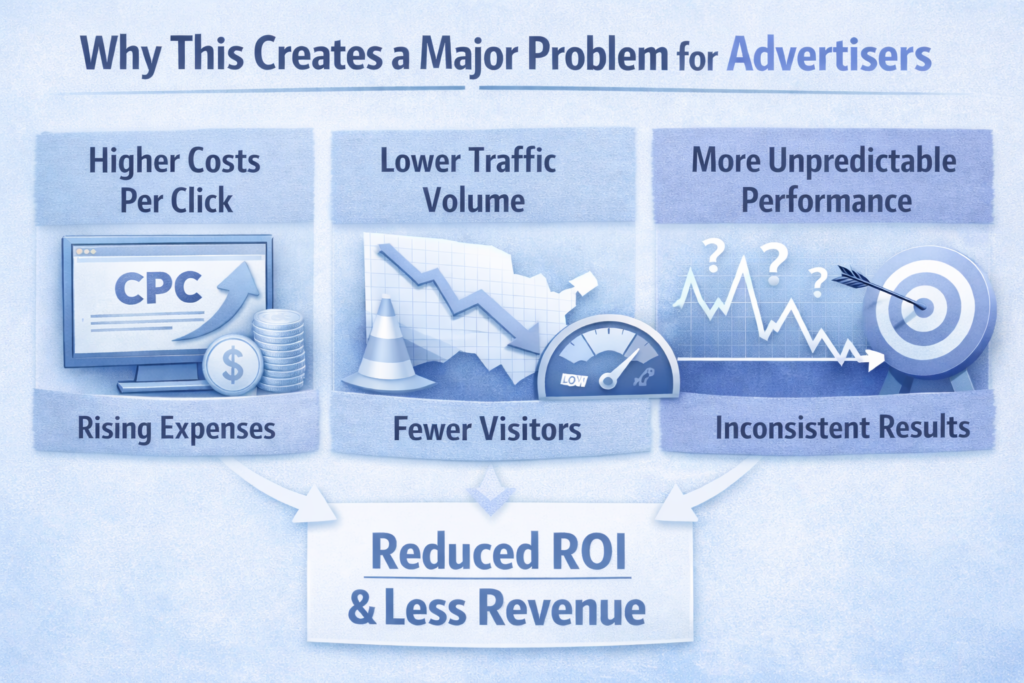
The result is predictable:
- Higher costs per click
- Lower traffic volume
- More unpredictable performance
If your entire strategy is built around “buying clicks,” the math is going to break down.
Should You Still Use Google Ads in 2026?
Short answer: Yes.
Longer answer: Only if you’re willing to adapt.
Here’s what I want to be clear about: If your Search, Shopping, or Performance Max campaigns are profitable today, don’t panic and turn everything off.
For most businesses:
- 2025: Things will stay mostly stable
- 2026: Some businesses will feel the impact more than others
The goal here isn’t to scare you. It’s to help you prepare.
What’s NOT Changing (This Is Important)
Despite all the disruption, some core truths about Google Ads remain solid:
1. Google Ads Is Still Auction-Based
The highest bidder doesn’t automatically win. Your ad relevance, landing page quality, and user experience matter just as much as your bid.
2. Google Ads Was Never Just About Keywords
Think about it Google even changed the name from “Google AdWords” to “Google Ads” back in 2018. That was a signal.
Over the years, Google has:
- Added audience targeting
- Integrated YouTube, Display, and Discovery
- Built tools that go way beyond simple keyword matching
Google Ads is an ecosystem, not just a keyword bidding tool.
3. Keywords Aren’t the Starting Point Anymore
In 2026, Google will evaluate your ads based on:
- Past user behavior
- Audience signals and demographics
- Device and location context
- Overall intent, not just keyword match
Your relevance will be judged holistically. A single keyword match won’t be enough.
3 Warning Signs to Watch for in Your Account
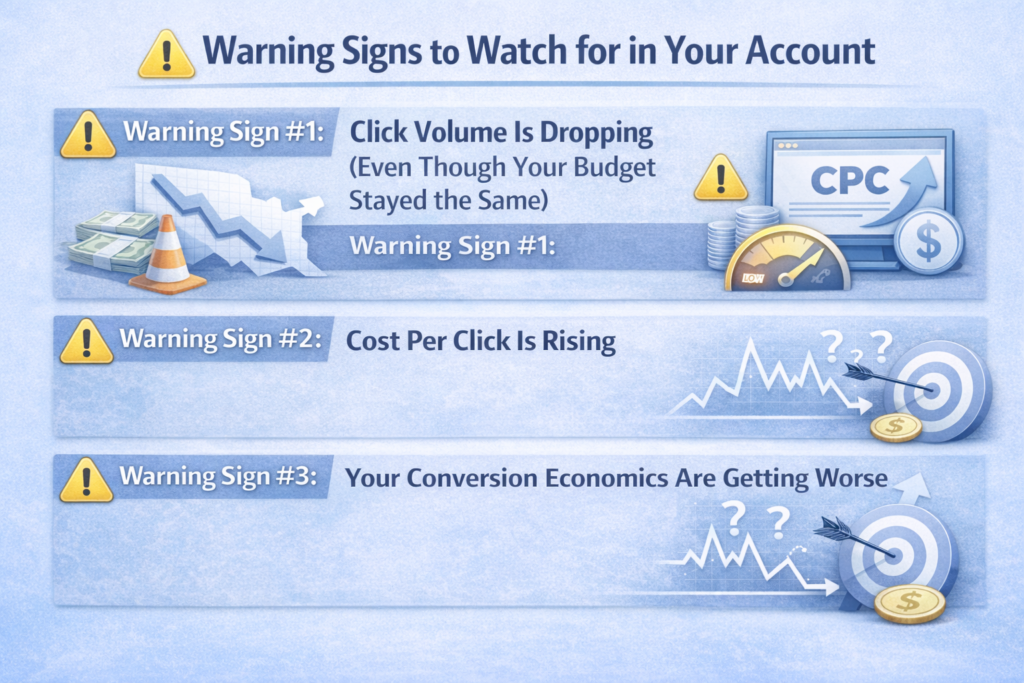
If you’re running Google Ads right now, check these metrics every month:
Warning Sign #1: Click Volume Is Dropping (Even Though Your Budget Stayed the Same)
Example:
- January: 2,000 clicks
- February: 1,800 clicks
- March: 1,500 clicks
If you see this pattern and you haven’t changed anything, that’s your first warning.
Warning Sign #2: Cost Per Click Is Rising
Your clicks used to cost ₹300, then ₹450, now ₹600—and you haven’t changed your bids.
This isn’t because your campaigns are broken. It’s because clicks are becoming scarce.
Warning Sign #3: Your Conversion Economics Are Getting Worse
- Cost per acquisition is climbing
- Conversion rates are dropping
- Return on ad spend is decreasing
Usually, all three happen together.
Why This Happens
AI Mode in Google Search reduces how many ad placements are visible. Ads only show up in AI Mode when:
- You’re using AI Max campaigns
- You have broad match keywords enabled
- Performance Max is feeding into search
Less ad inventory means more expensive clicks. It’s basic supply and demand.
A poor Google Ads account structure makes AI-driven bidding and automation significantly less effective. If you’re rebuilding campaigns for 2026, read my Google Ads account structure guide where I explain how modern campaign structures should be organised for better scaling and cleaner optimisation.
Want help improving your Google Ads performance in 2026?
I help businesses fix campaign structure issues, improve conversion tracking, optimise audience signals, and scale Google Ads campaigns profitably with AI-driven strategies.
What to Do If Your Performance Starts Dropping
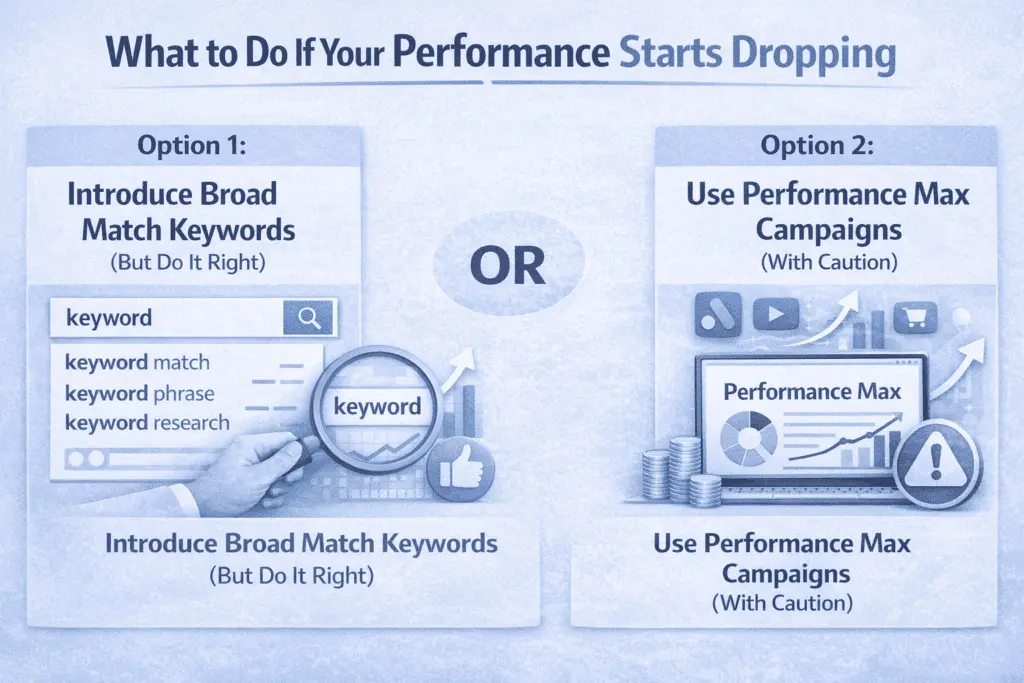
If you’re seeing these warning signs, you have two main strategic options.
Option 1: Introduce Broad Match Keywords (But Do It Right)
This is especially important if:
- You run lead generation campaigns
- You’re in a high cost-per-click industry
- You’re still only using exact and phrase match
How to test broad match safely:
- Add just one broad match keyword per ad group
- Choose keywords based on 3-4 months of actual search term data
- Pick keywords that already convert well
- Use longer, more specific phrases (4-5 words work better)
If you’re running Performance Max campaigns, campaign structure and conversion data quality matter even more in 2026. I explained my full setup process in this Performance Max campaign setup guide.
Example:
Instead of the broad keyword:
- “digital marketing course”
Use something more specific:
- “advanced google ads course for ecommerce brands”
Important reminders:
- Expect a learning period where performance might wobble
- Check your search terms report frequently
- Add negative keywords aggressively
Broad match without regular monitoring will waste your budget fast.
Option 2: Use Performance Max Campaigns (With Caution)
For eCommerce brands:
Performance Max is generally easier to adopt because:
- You already have clear conversion values
- Product feeds provide strong signals
- It scales well if your creative and product data are solid
For lead generation brands:
Be careful here. Performance Max needs strong conversion signals to work properly.
If you don’t have:
- Offline conversion tracking set up
- CRM integration with Google Ads
- A way to tell Google which leads are actually good
…then Performance Max might optimize toward low-quality leads that waste your time.
The Big Strategic Shift You Must Accept
Google Ads in 2026 is fundamentally moving from:
❌ Buying specific keywords to ✅ Matching intent using signals
Advertisers who win in 2026 will:
- Prioritize ad relevance over manual control
- Invest in landing page quality
- Build stronger first-party data
- Use audience targeting intentionally
- Measure success beyond just clicks
My Practical Advice (From Someone Actually Running Campaigns)
If I were managing accounts today (and I am), here’s what I’d do:
I would NOT:
- Panic and overhaul everything overnight
- Obsess over having “perfect control” with exact match
- Focus on vanity metrics like click-through rate
I WOULD:
- Gradually test broad match keywords in controlled ways
- Properly prepare Performance Max campaigns with good data
- Improve my conversion tracking to capture more signals
- Invest more time in creative quality and messaging
- Watch my warning signs closely every month
Frequently Asked Questions About Google Ads in 2026
Will Google Ads still work in 2026?
Yes, Google Ads will absolutely still work in 2026, but only for advertisers who adapt to the changing landscape. The platform itself isn’t dying, but traditional strategies that rely solely on exact match keywords and basic click-buying are becoming less effective. Businesses that focus on intent matching, audience signals, and quality relevance will continue to see strong results.
Why are my Google Ads costs increasing?
Your costs are likely increasing due to click scarcity. With Google’s AI Mode providing answers directly in search results, fewer people are clicking on ads. When the same number of advertisers compete for fewer available clicks, basic supply and demand economics push costs per click higher. This isn’t a sign of poor campaign management it’s a market shift.
What is Google AI Mode and how does it affect my ads?
Google AI Mode is a feature in Google Search that provides AI-generated answers directly on the search results page. This means users get information without clicking through to websites or ads. For advertisers, this means fewer impressions and clicks available, particularly for informational searches. Ads still appear in AI Mode, but primarily through AI Max campaigns and broad match keywords.
Should I switch to broad match keywords in 2026?
Broad match keywords will become increasingly important in 2026, but you should transition carefully. Start by adding one broad match keyword per ad group based on proven search term data. Use longer, intent-rich phrases (4-5 words) rather than short generic terms. Monitor your search terms report frequently and add negative keywords aggressively to prevent wasted spend.
Is Performance Max better than Search campaigns?
Performance Max isn’t necessarily better it’s different. For eCommerce businesses with clear conversion values and solid product feeds, Performance Max often scales well. For lead generation businesses, it can be risky without proper offline conversion tracking and CRM integration. The best approach is usually to run both: keep profitable Search campaigns running while testing Performance Max with proper tracking in place.
Are keywords becoming irrelevant in Google Ads?
No, keywords are not becoming irrelevant, but they’re no longer the primary signal Google uses. In 2026, Google evaluates ad relevance using a combination of keywords, audience signals, user behavior, demographics, device context, and overall intent. Keywords still matter, but they’re one factor among many rather than the sole determining factor.
What metrics should I track in 2026?
Focus on three critical warning signs: declining click volume without budget changes, rising cost per click for the same campaigns, and worsening conversion economics (higher CPA, lower conversion rate, reduced ROAS). These metrics together tell you if click scarcity is affecting your account. Also prioritize tracking conversion value and customer lifetime value rather than just click-through rates.
Should I pause my Google Ads campaigns until things stabilize?
Absolutely not. If your campaigns are profitable today, keep them running. The transition to the new reality will be gradual through 2025 and into 2026. Pausing now means you’ll lose valuable data and signals that Google needs to optimize your campaigns. Instead, adapt gradually by testing new match types, improving conversion tracking, and monitoring your warning signs monthly.
How can I prepare my Google Ads account for 2026?
Start by improving your conversion tracking to capture more signals. Gradually test broad match keywords in controlled ad groups. If you’re in eCommerce, prepare Performance Max campaigns with quality product feeds and creative. Invest in landing page quality and relevance. Build stronger first-party data through CRM integration. Most importantly, shift your mindset from controlling keywords to matching user intent.
Will exact match keywords stop working completely?
Exact match keywords won’t stop working, but Google has already loosened what “exact match” means over the years. They’ll continue to have a place in your strategy, especially for branded terms and high-intent commercial queries. However, relying exclusively on exact and phrase match will limit your reach as search becomes more conversational and AI-driven. A balanced approach using multiple match types will work best.
What is the biggest mistake advertisers make preparing for 2026?
The biggest mistake is doing nothing and hoping things return to how they used to be. The second biggest mistake is panicking and completely overhauling profitable campaigns overnight. The right approach is gradual adaptation: test new strategies in small portions of your account, monitor results closely, and scale what works while maintaining what’s already profitable.
How will AI Max campaigns work in 2026?
AI Max campaigns are designed to show ads within Google’s AI Mode search results. They use broad match keywords and audience signals to match user intent rather than specific keyword queries. To work effectively, AI Max requires strong conversion data, quality creative assets, and clear business goals. They’ll become increasingly important as more searches happen within AI Mode rather than traditional search results.
The biggest mistake advertisers will make in 2026 is relying on outdated Google Ads strategies while AI-driven systems continue evolving.
The businesses getting the best results are the ones adapting early with better account structure, cleaner conversion data, stronger creatives, and smarter automation workflows.
If you want help improving your Google Ads strategy for 2026, scaling campaigns profitably, or preparing your account for the next generation of AI advertising, let’s work together.
👉 Schedule a Google Ads Strategy Call
Final Thoughts
Google Ads is not dying. But the old way of doing Google Ads is.
The advertisers who thrive in 2026 won’t be the ones looking for shortcuts, fighting against automation, or clinging to exact match keywords.
They’ll be the ones who:
- Understand user intent deeply
- Respect how the auction actually works
- Build relevance at scale
If you start preparing now not in six months, but now 2026 won’t hurt you. It might even reward you.
The question is: are you going to adapt, or are you going to hope things go back to how they used to be?
Because I can tell you right now they won’t.
