

Google Demand Gen: How Smart Brands Create Demand Before Customers Start Searching


For a long time, digital advertising worked in a very simple way. If someone searched for something online, brands showed them ads related to that search. This worked well, but it didn’t tell the full story.
Today, people don’t always search before buying something. They often discover brands while watching YouTube Shorts, scrolling through Google Discover, or checking their emails. Many times, they already like or trust a brand before they ever search for it. That’s where Google Demand Gen comes in.
Demand Gen is not about showing ads only when people are ready to buy. It’s about showing your brand earlier, when people are just browsing and exploring. This helps brands build awareness, shape how people feel about them, and stay in people’s minds so when they are ready to buy, your brand is the first one they think of.
What Is Google Demand Gen?
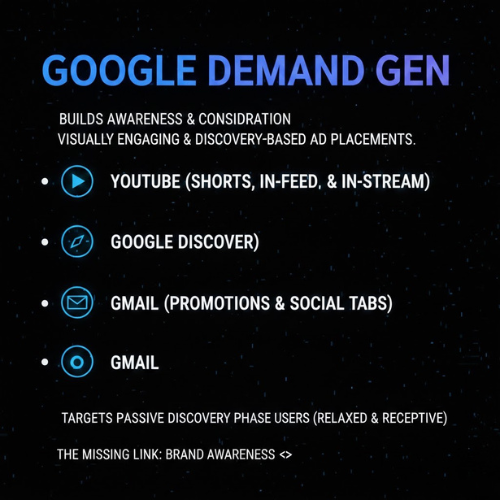
Google Demand Gen is a type of campaign in Google Ads that aims to build awareness and
consideration through visually engaging and discovery-based ad placements. Demand Gen ads are shown on the following surfaces:
- YouTube (Shorts, in-feed, and in-stream)
- Google Discover
- Gmail (Promotions and Social tabs)
Demand Gen campaigns target users in a passive discovery phase, which means the users are in a relaxed and receptive state of mind, as opposed to Search campaigns, where users are actively searching for something. Consider Demand Gen campaigns to be the missing link between brand awareness and performance marketing.
The Strategic Shift: From Intent Capture to Intent Creation
One of the biggest errors that advertisers make is to expect Demand Gen to act like Search or Performance Max. It doesn’t and it shouldn’t. Search ads are effective when the intent is already there. Demand Gen is effective when the intent hasn’t been created yet. This is important. Demand Gen enables brands to:
Launch products before customers even know they want them Create familiarity through repeated exposure Influence preferences during the early stages of decision-making Warm up audiences for future conversion campaigns. In competitive markets, the brand that wins is often the one that customers know, not the one with the lowest price.
Budget Estimates for Google Demand Generation Initiatives
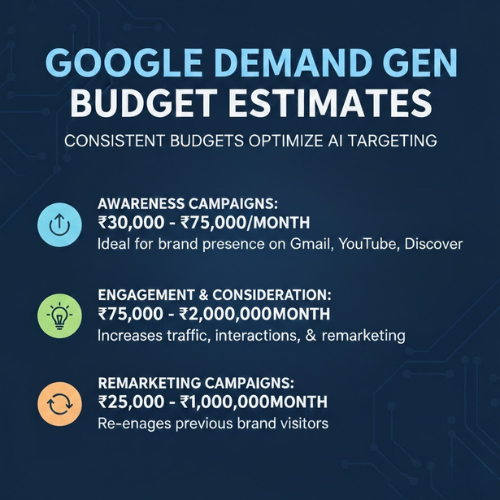
Consistent budgets that enable Google’s AI to maximise audience targeting and delivery are ideal for Google Demand Gen campaigns.
- Monthly budget for awareness campaigns: ₹30,000 to ₹75,000
- Ideal for boosting brand awareness on Gmail, YouTube, and Discover.
- Campaigns for engagement and consideration: ₹75,000 to ₹2,000,000 per month
- Perfect for increasing traffic, interactions, and remarketing audiences.
- Marketing campaigns: ₹25,000 to ₹1,000,000 every month
useful for bringing users back into contact with the brand after they have already interacted with it.
How Demand Gen Is Different from Discovery and Performance Max
Demand Gen replaces Discovery Ads, but it is much more sophisticated. It has better creative capabilities, analytics and integration with YouTube, making it more strategic and transparent. At the same time, it does a completely different job than Performance Max. Performance Max is optimized for the sale. Demand Gen is optimized for the start of the conversation. While Performance Max is optimized for efficiency and conversions, Demand Gen is optimized for:
- Storytelling
- Brand recall
- Emotional connection
- Mid-funnel engagement
- Together, they make for a very powerful full-funnel strategy.
If you’re also running Performance Max campaigns, understanding how Demand Gen complements automated campaign types is important for full-funnel scaling.
Audience Targeting: Where Demand Gen Really Shines
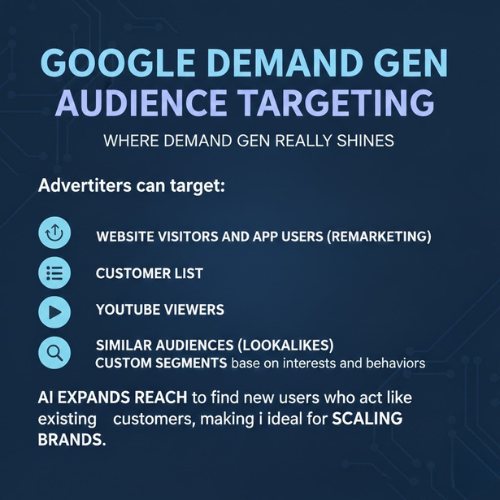
One of the most compelling features of Demand Gen is its audience intelligence.
Advertisers can target:
- Website visitors and app users (remarketing)
- Customer lists
- YouTube viewers
- Similar audiences (lookalikes)
- Custom segments based on interests and behaviors
Google’s AI then intelligently expands reach, finding users who act like your existing customers even if they’ve never interacted with your brand before. This makes Demand Gen particularly useful for scaling brands that have already gathered some audience data and want to expand beyond it.
If your ads are getting impressions but not building real demand, the problem is usually audience strategy, creative positioning, or campaign structure.
I help brands improve:
- Audience targeting
- YouTube engagement
- Creative strategy
- Lead quality
- Full-funnel campaign performance
Creative Strategy: Why Most Demand Gen Campaigns Fail
The number one reason why Demand Gen campaigns are underperforming is not targeting its creative. Demand Gen is a visual-first medium. If your creatives look like banner ads or sales promotions, users will scroll right past them. Great Demand Gen creatives typically:
- Talk about lifestyle, not just products
- Show the product in action in the real world
- Trigger curiosity or an emotional response
- Look native on YouTube or Discover
- Not be super sales-y or discount-heavy
Short-form video, especially vertical video, performs amazingly well especially on YouTube Shorts. The point is not to sell. The point is to be remembered.
Where Demand Gen Fits in the Marketing Funnel
Demand Gen exists in the upper and mid-funnel, but its ripples extend downstream.
A good Demand Gen campaign:
- Boosts branded search volume
- Improves remarketing performance
- Reduces acquisition costs over time
- Enhances Performance Max results
Most advertisers are missing the benefits of Demand Gen because they are only attributing conversions to the last-click campaign. Demand Gen drives decisions that occur days or weeks later in other campaigns.
Measuring Success the Right Way
Demand Gen necessitates a different approach to measurement. Rather than concentrating solely on direct conversions, brands ought to monitor:
Rates of engagement (views, interactions)
- Frequency and reach
- View through and assisted conversions
- An increase in searches for brands
- Improvement in remarketing campaign performance
Studies on brand lift can also offer insightful information about metrics that are important in the long run, such as awareness, recall and consideration. Demand Gen is not about quick wins. It has to do with growth that is sustainable.
FAQs About Google Demand Gen
Is Google Demand Gen suitable for small businesses?
Yes, but expectations matter. When budgets are carefully scaled, small businesses with compelling visuals and clear messaging can achieve great results.
How much budget does Demand Gen require?
Demand generation is most effective when spent consistently over time. As Google’s AI collects more data, performance increases even though it can operate on modest budgets.
Can Demand Gen be used for remarketing?
Absolutely. Remarketing audiences often perform extremely well in Demand Gen, especially when paired with storytelling-focused creatives.
Does Demand Gen replace Search or Performance Max?
No. Demand Gen complements them. Search captures demand, Performance Max converts demand and Demand Gen creates it.
How long does optimization take?
Most Demand Gen campaigns need at least 2–4 weeks to exit the learning phase and show meaningful patterns.
Demand Gen campaigns perform best when they are part of a properly organised Google Ads account structure with clear audience segmentation and campaign objectives.
Conclusion
Google Demand Gen reflects a fundamental shift in the way modern advertising functions. It recognises that brand influence often happens long before intent is evident and that consumers don’t always look first. Demand Gen combines strategic audience growth, eye-catching imagery, and premium placements to allow brands to shape demand rather than chase it. For businesses that value long-term growth, brand strength and scalable performance, Google Demand Gen is a strategic advantage in the increasingly competitive digital landscape.
